Recently I received a radio built by Stephen McGreevy, N6NKS. The WR-3 is a hand-held VLF receiver designed for especially for listening to naturally-occurring extremely low frequency (ELF) and very low frequency (VLF) radio phenomena, like lightning storm atmospherics. The WR-3 converts 0.2-11 kHz radio frequencies directly to audio signals, which can be monitored and recorded directly from a portable hand-held unit powered with a 9-volt battery. Using this and similar models, Stephen produced five natural VLF radio MP3 Albums, including, "Electric Enigma" and "Aurora Chorus". For an example listen here.
As Steve notes, "Everyone has seen or has at least heard of the hauntingly beautiful Aurora Borealis or Northern Lights but only a select and elite few have experienced their spectacular, compelling and beautiful sound". Steve has for the first time in history, captured and recorded "the sounds of the Aurora Borealis and the EMF discharges of lightning bolts bouncing and stretching through the earth's magnetosphere."
Yesterday afternoon I drove out to a place called Little Mountain on the Natchez Trace Parkway at Jeff Busby Campground in Mississippi, turned off my car, plugged in some iPhone earbuds and then the W3R. Initially the earbuds literally buzzed in my hand after I turned on the receiver; I'm glad I did not have them in my ears, but I had read about this and knew to be careful.
After adequately grounding the radio (or was it just hand capacitance?) the earbuds stopped chattering in my hand and I carefully put them in my ears. First I heard a slight bit of power-line hum and lots of noisy interference, which I attributed to some large machinery a few miles away. The North American Coal Corporation’s Red Hills Mine is just a few miles away, in Ackerman, MS.
I moved the radio to the other side of parking lot at the top of Little Mountain and things settled down nicely. I then could hear some actual sferics, but they were quite distant I'm sure - the weather in the southeast is now very calm so I figured it was from some thunderstorms in the Midwest. I never heard any whistlers or anything quite so dramatic as what McGreevy has recorded, but I did hear insects flying near the antenna. McGreevy notes that, "this effect is caused by electrostatic discharges each time the insect's wings flap".
Later I moved to another location on the Natchez Trace, and tried again. This time there was quite a bit of power line hum; I was sitting in my car with the antenna propped on the plastic side-view mirror enclosure and the radio resting on my left bare leg. After I placed my hand on the side of the car outside the hum disappeared entirely. Ahh...properly grounded, I think. Then faintly I hear what sounds like an alarm clock beep beep beeping just above the noise floor. I'm not sure what it was, but I timed and counted and came up with between 220 and 240 beats/beeps per minute. After about 10 minutes it abruptly stopped. I heard more insects too, and more distant lightning sferics.
I'm looking forward to spending more time with this radio and learning more about natural ELF and VLF emissions. It suits me well, as I enjoy spending time outdoors and in remote places.
Wednesday, September 15, 2010

Wednesday, September 8, 2010
Fun with Google Instant

Google Instant is Google’s newest search engine; just start typing in search terms and Google will display real-time suggestions and even the page results.
For example, typing in, "lollipops are " results in lollipops are illegal in Washington; typing in, "science is " displays Science is real, while religion is the opiate of the masses -
I suppose Karl Marx would be proud, even if perhaps out of context.
As a followup to science and religion (note however I don't give much credence to the warfare hypothesis), I entered some selected topical subjects about politics, and found that:
sarah palin has breast implants, and...
breast implants are gross.
Well that's plain, and droll, enough - how about we start with the president:
Obama will not rest, yet...
the GOP looks west, and...
the West is the best, which is...
the best thing I ever ate.
Actually the best thing I ever ate was mother's home made lasagne, and my grandmother's vanilla ice cream...still, you can have some fun with Google Instant, even if it still has some way to go.
Where's My Hat
Housekeeping on my laptop...here's a trivial little fragment I wrote a few years ago. I was playing around with a symmetrical rhyme scheme using couplets and never finished it:
I have a funny hat.
I'm not sure where it's at.
Perhaps it on the kitchen table.
But this may be a feeble fable.
Perhaps it's on my own portmanteau.
Or out on loan to my friend, Thoreau,
Who makes a stir with his own chapeau,
Covered in mink and azure sable,
Worn in town or at the stable.
etc....
I have a funny hat.
I'm not sure where it's at.
Perhaps it on the kitchen table.
But this may be a feeble fable.
Perhaps it's on my own portmanteau.
Or out on loan to my friend, Thoreau,
Who makes a stir with his own chapeau,
Covered in mink and azure sable,
Worn in town or at the stable.
etc....
Saturday, August 28, 2010
How to Unfriend Someone on Facebook
Discussions revolve around the correct use of unfriend (or should it be de-friend), and reasons why one would want to unfriend someone (e.g., 8 Reasons Why), yet the actual process itself is not mentioned much, most likely because processes change, and people assume it to be as simple as the friending (or is it the befriending) process.
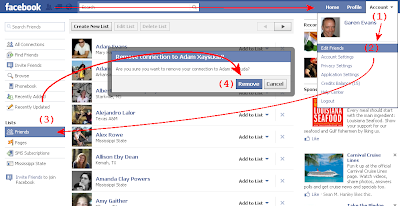
Unfriending in Four Easy Steps
It's actually pretty simple, but does require a few mouse clicks. Click on Account (page upper right next to Home...Profile...), and select Edit Friends; this will open a page where on the left side you will see Lists, under which are links to: Friends, Pages, SMS Subscriptions, etc.; click on Friends. You will see all of your friends listed and an X next to their name. Click on the X next to the friend you want removed, and when a confirmation window is displayed, click on Remove. That's all there is to it.
Unfriending in Four Easy Steps
It's actually pretty simple, but does require a few mouse clicks. Click on Account (page upper right next to Home...Profile...), and select Edit Friends; this will open a page where on the left side you will see Lists, under which are links to: Friends, Pages, SMS Subscriptions, etc.; click on Friends. You will see all of your friends listed and an X next to their name. Click on the X next to the friend you want removed, and when a confirmation window is displayed, click on Remove. That's all there is to it.

Wednesday, August 11, 2010
Tropical Depression FIVE (Advisories 1-4)
This is an animated image of NOAA's Coastal Watches/Warnings and 5-Day Track Forecast Cone for Tropical Depression FIVE. The animation is based on advisories 1 through 4, the most recent of which, Advisory 4, was released at 10AM (Central Time) on Wed August 11, 2010.

Wednesday, July 28, 2010
Cost of the BP Oil Spill
The cost to clean up an oil spill is a function of many factors, including economic losses, environmental damage, and legal fees. Many of the costs come from cleanup personnel and the opportunity costs as employees focus on spill-related objectives, rather than their usual duties. Additional costs which might be overlooked include things such as regulatory and permitting changes, and capital investment costs as new equipment is purchased.
As of 22 July, the BP Oil Spill was between 50.7 and 145 million gallons of crude oil, or between 1.21 and 3.45 million barrels. Using the Oil Spill Cost Calculator, which was developed at Texas A&M University by Kartik Gandhi and Vijay Chennoju, I estimated that the cost of cleanup is between $7.6 billion and $43.5 billion. These estimates are based on a simple cost ratio and may not account for many economic and environmental losses, including adverse impacts on tourism, commercial fisheries, recreational and entertainment services, and others.
Sources:
NYT Oil Spill Tracker
http://www.nytimes.com/interactive/2010/05/01/us/20100501-oil-spill-tracker.html
Professor Hann's Oil Spill Technology Page
https://ceprofs.civil.tamu.edu/rhann/index1.asp
ESTIMATING CLEANUP COSTS FOR OIL SPILLS
Dagmar Etkin, Oil Spill Intelligence Report, Cutter Information Corp., Arlington, Massachusetts, U.S.
http://www.environmental-research.com/erc_papers/ERC_paper_1.pdf
As of 22 July, the BP Oil Spill was between 50.7 and 145 million gallons of crude oil, or between 1.21 and 3.45 million barrels. Using the Oil Spill Cost Calculator, which was developed at Texas A&M University by Kartik Gandhi and Vijay Chennoju, I estimated that the cost of cleanup is between $7.6 billion and $43.5 billion. These estimates are based on a simple cost ratio and may not account for many economic and environmental losses, including adverse impacts on tourism, commercial fisheries, recreational and entertainment services, and others.
Sources:
NYT Oil Spill Tracker
http://www.nytimes.com/interactive/2010/05/01/us/20100501-oil-spill-tracker.html
Professor Hann's Oil Spill Technology Page
https://ceprofs.civil.tamu.edu/rhann/index1.asp
ESTIMATING CLEANUP COSTS FOR OIL SPILLS
Dagmar Etkin, Oil Spill Intelligence Report, Cutter Information Corp., Arlington, Massachusetts, U.S.
http://www.environmental-research.com/erc_papers/ERC_paper_1.pdf
Thursday, July 22, 2010
CCA Ceviche
1 pound medium shrimp, tails removed & deveined
½ cup fresh orange juice (1 large)
¼ cup fresh lime juice (1 large)
1 serrano chili, diced
½ cup red onion, diced
2 cups watermelon, cubed
1 mango, cubed
3-4 mint leaves, cut into thin strips
2 tlbs. orange zest
1 tlbs. grated ginger
Coarse sea salt
Coarse black pepper
Bring 1 quart pot of salted water to a boil and add shrimp. Turn off the heat & let the shrimp sit in the hot water until cooked thru, 2-3 minutes. This ensures the shrimp will stay tender. Drain the water & place shrimp in a large bowl. Add the citrus juices & diced serrano. Cover and marinate at least 15 minutes.
Pour off most of the juices & add the watermelon, mango, red onion, & mint. Toss lightly. Add the ginger, the orange zest, and top with the salt & pepper immediately before serving. Garnish with a sprig of mint and lime wedge.
Serves 4-6
Source:
CCA Tide magazine July/Aug 2010
Julie Hettiger, Food Stylist & Culinary Consultant
Juliehettiger.com
½ cup fresh orange juice (1 large)
¼ cup fresh lime juice (1 large)
1 serrano chili, diced
½ cup red onion, diced
2 cups watermelon, cubed
1 mango, cubed
3-4 mint leaves, cut into thin strips
2 tlbs. orange zest
1 tlbs. grated ginger
Coarse sea salt
Coarse black pepper
Bring 1 quart pot of salted water to a boil and add shrimp. Turn off the heat & let the shrimp sit in the hot water until cooked thru, 2-3 minutes. This ensures the shrimp will stay tender. Drain the water & place shrimp in a large bowl. Add the citrus juices & diced serrano. Cover and marinate at least 15 minutes.
Pour off most of the juices & add the watermelon, mango, red onion, & mint. Toss lightly. Add the ginger, the orange zest, and top with the salt & pepper immediately before serving. Garnish with a sprig of mint and lime wedge.
Serves 4-6
Source:
CCA Tide magazine July/Aug 2010
Julie Hettiger, Food Stylist & Culinary Consultant
Juliehettiger.com
Subscribe to:
Posts (Atom)